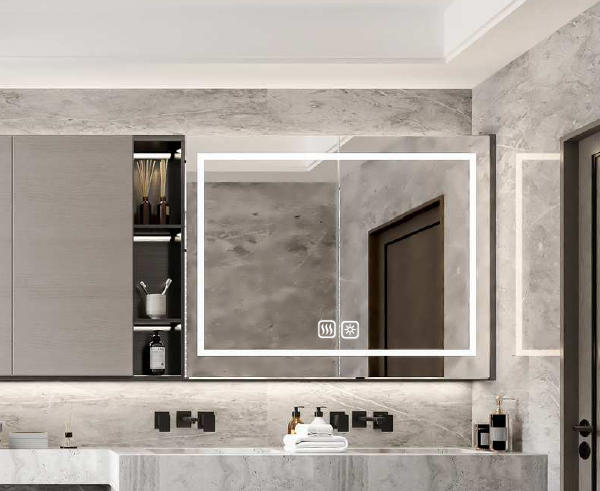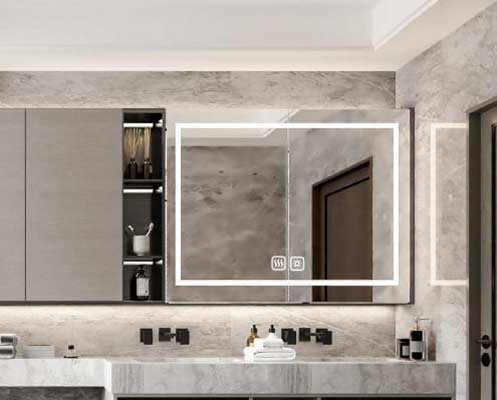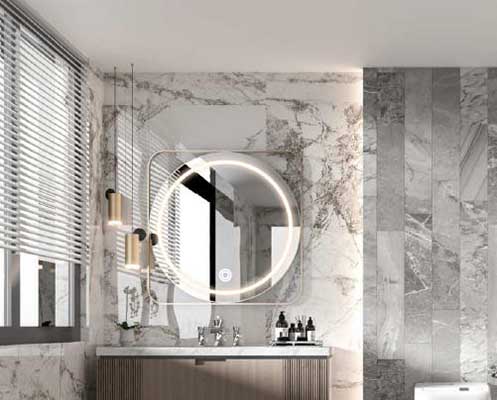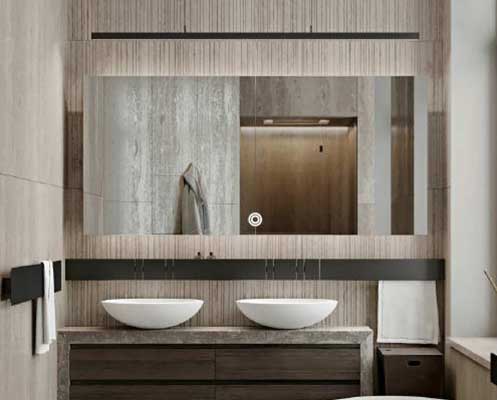
Compare standard, LED, backlit, anti-fog, cabinet, magnifying, and smart bathroom mirrors. Find the best type for your space, budget, and grooming needs.
1. Introduction: Why the Right Bathroom Mirror Matters
A bathroom mirror is not just a reflective surface. It is the hardest-working fixture in your daily routine.
You use it to shave, apply makeup, brush your teeth, and check your appearance. A poor mirror makes these tasks harder. A good one makes them effortless.
The problem is choice. Walk into any showroom or browse online, and you will find dozens of options. Standard flat mirrors, LED mirrors, anti-fog mirrors, medicine cabinets, magnifying mirrors, and smart mirrors all compete for your attention.
Most buyers focus on the wrong specs first. They ask about wattage or frame color before asking a simpler question: What do I actually need this mirror to do?
This guide breaks down every major bathroom mirror type. You will learn the real pros and cons of each. You will see side-by-side comparisons. And you will finish with a clear answer to one question: Which one is right for me?
2. Key Factors to Consider Before Choosing a Bathroom Mirror
2.1 Size, Shape & Mounting Style
Size is the most common mistake in bathroom mirror purchases.
The mirror should relate to the vanity below it. A good rule: mirror width should be 70–80% of the vanity width. A 600mm vanity works well with a 420–480mm mirror. A 1000mm vanity pairs with a 700–800mm mirror.
For round mirrors, use 60–70% of the vanity width instead. Round mirrors have less reflective area per width.
Shape sets the visual tone before anything else. Round mirrors soften rooms full of straight lines. Rectangular mirrors maximize usable reflection. Oval and pill shapes sit between the two—oval reads organic, pill reads architectural.
Mounting style matters too. Wall-mounted mirrors save counter space. Recessed mirrors sit flush in the wall but need cavity depth. Surface-mounted mirrors are easiest to install.
2.2 Lighting & Visibility Needs
Your mirror needs light. But the type of light matters more than most buyers realize.
Color temperature is measured in Kelvin (K). Warm white (2700–3000K) feels relaxing. Neutral white (3500–4000K) is the safest default for daily use. Cool white (4500–5000K) works best for makeup application.
Shadow direction matters too. A single overhead light casts shadows under your eyes and chin. The fix is front-lit illumination—light that hits your face directly, not just behind the mirror.
For grooming-focused bathrooms, look for a CRI (Color Rendering Index) of at least 80. Higher CRI means colors look more true to life under that light.
2.3 Anti-Fog & Moisture Resistance
A fogged mirror is useless right after a hot shower. Anti-fog (demister) mirrors solve this with a heated pad behind the glass.
The pad warms the mirror surface slightly above room temperature. Fog cannot form on warm glass.
Is a demister worth it? It adds £30–£80 to the mirror price. In a busy, humid bathroom, it earns that cost. In a well-ventilated single-user bathroom, it is optional.
IP ratings matter for any electric mirror. For Zone 2 (within 600mm of a water source), look for IP44 minimum. Most bathroom mirrors sit in Zone 2.
2.4 Storage & Functionality
A mirror can do more than reflect. Medicine cabinet mirrors hide shelves behind a mirrored door.
This clears countertop clutter. Toothpaste, skincare, and shavers go behind the glass instead of on the counter.
Surface-mounted cabinets are easier to install and hold more. Recessed cabinets sit flush and save space but need a wall cavity of at least 100mm, clear of pipes and wiring.
Other functional features include shaver sockets, magnifying insets, and touch controls. Each adds cost. Each needs to earn its place in your routine.
2.5 Budget & Energy Efficiency
Bathroom mirror prices vary widely. A basic frameless mirror costs little. A large LED smart mirror with a demister and Bluetooth can run into the hundreds.
Energy use is small for most mirrors. LED strips draw little power. A demister pad runs only when needed. The bigger cost is the initial purchase and installation.
If wiring is needed, factor in an electrician. Hard-wired mirrors require Part P compliance in the UK. Plug-in mirrors connecting to a fused spur are simpler for confident DIYers.
3. Different Types of Bathroom Mirrors
3.1 Standard Flat Wall Mirrors
What they are: A plain mirror with no built-in light, no heater, and no electronics.
Best for: Budget-conscious buyers, well-lit bathrooms, or anyone who wants a clean look without complexity.
Pros:
- Lowest cost of any bathroom mirror type
- No wiring required
- Easiest to install
- Wide range of frames and shapes
Cons:
- Foggy after showers
- Relies on room lighting for grooming tasks
- No extra features
A standard mirror works well if your bathroom already has excellent lighting. If not, a LED mirror is usually a better choice.
3.2 LED-Lit & Backlit Mirrors
What they are: Mirrors with integrated LED illumination. Two main types exist.
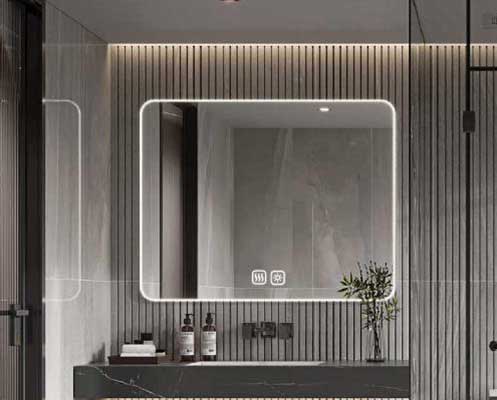
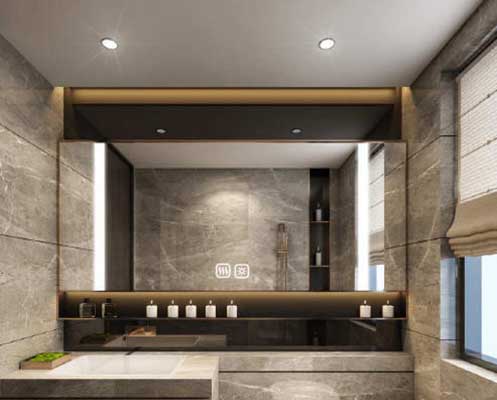
Front-lit mirrors put LEDs around the mirror’s face. Light hits your face directly. This is the better choice for grooming tasks.
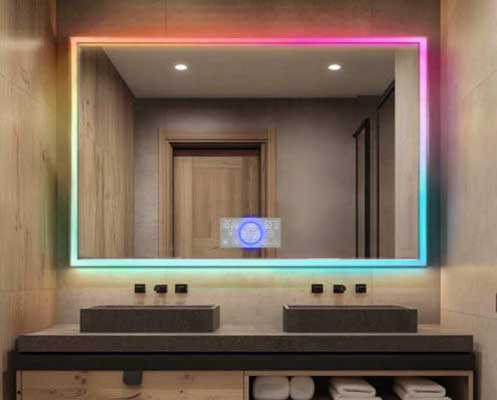
Backlit (edge-lit) mirrors put LEDs behind the mirror. Light spills onto the wall around the mirror. This creates a soft halo effect. It looks atmospheric. But it provides less direct face light.
Pros:
- Built-in light for shaving and makeup
- Many models offer color-temperature switching (warm to cool)
- Some include memory function to remember your last setting
- Clean, modern look
Cons:
- Requires electrical connection
- Higher cost than standard mirrors
- Backlit models may not provide enough task light
Key specs to check: Color temperature options, lumens output, and whether the light is front-facing or edge-only.
3.3 Anti-Fog (Demister) Mirrors
What they are: Mirrors with a heated pad behind the glass. The heat prevents condensation from forming on the surface.
How it works: A thin heating element warms the mirror to just above room temperature. Fog needs a cool surface to condense. Warm glass stays clear.
Pros:
- Always clear after a shower
- No wiping needed
- Often combined with LED lighting
Cons:
- Adds cost
- Uses a small amount of electricity
- Wasted feature in well-ventilated bathrooms
Do you need one? If multiple people shower in sequence, or if your bathroom has poor ventilation, yes. If you shower once a day and have a window or extractor fan, a demister is a nice extra but not essential.
3.4 Medicine Cabinet Mirrors
What they are: A wall cabinet with a mirrored door. The mirror is the front. Shelves are hidden behind it.
Two mounting types:
| Type | How It Mounts | Storage | Install Difficulty | Best For |
|---|---|---|---|---|
| Surface-mounted | Fixes to wall face | Full depth | Easy | Rentals, any solid wall |
| Recessed | Sits inside wall cavity | Slightly less | Moderate | Small bathrooms, flush look |
Pros:
- Hidden storage clears the counter
- Mirror and cabinet in one footprint
- Modern versions add LED lighting and demisters
Cons:
- Recessed models need wall cavity space
- Surface-mounted units protrude 10–15cm into the room
- More expensive than a flat mirror of the same size
Sizing tip: Cabinet width should be 70–90% of the basin width below it.
3.5 Magnifying & Extendable Mirrors
What they are: Smaller mirrors with a magnification lens, often on an extending arm or suction mount.
Magnification levels and their uses:
| Level | Best For |
|---|---|
| 3x | General grooming, broad face view |
| 5x | Everyday makeup, daily skincare, shaving |
| 7x | Eye makeup, lip lines, close shaving |
| 10x | Contact lenses, eyebrow shaping |
5x or 7x is right for most people. 10x has a narrow depth of field. It works for specific tasks but is frustrating for general use.
Pros:
- Reveals detail a standard mirror misses
- Extendable arms bring the mirror to you
- Some models are freestanding and portable
Cons:
- Magnification has a narrow focal range
- Illumination is important—magnified mirrors without light are hard to use
- Takes wall or counter space
Illuminated magnifying mirrors are dramatically more useful. Integrated LED solves the shadow problem.
3.6 Smart Mirrors (Touch Controls, Bluetooth, Defogger)
What they are: Mirrors with electronics beyond basic lighting. Features vary widely.
Common smart features:
| Feature | What It Does | Worth It? |
|---|---|---|
| Touch dimmer | Adjusts brightness with a tap | Yes, if you groom at different times of day |
| Color temperature switch | Warm to cool light selection | Yes, for multi-user bathrooms |
| Bluetooth speakers | Plays audio from your phone | Only if you will use it daily |
| Voice control | Hands-free commands | Novelty for most |
| Time/temperature display | Shows info on the mirror surface | Convenience feature |
| Motion sensor | Lights up when you approach | Useful for night use |
Pros:
- Combines many features in one unit
- Adds convenience and enjoyment
- Modern aesthetic
Cons:
- Higher cost
- More electronics mean more potential failure points
- Many features go unused after the first month
Privacy note: Smart mirrors with Wi-Fi, cameras, or microphones raise data concerns. Check the manufacturer’s privacy policy. Disable connectivity when not needed.
3.7 Frameless vs. Framed Mirrors
Frameless mirrors: The mirror edge is the frame. Polished or bevelled edges create the finish. Best for modern, minimalist bathrooms where the mirror should recede.
Framed mirrors: A visible frame surrounds the glass. Options include black, brass, chrome, wood, and more.
The coordination rule: Match visible metalwork as one family. A black-framed mirror pairs with matte black taps and handles. Mismatched metals are the most visible design error in a bathroom.
| Frame Type | Best For | Coordinates With |
|---|---|---|
| Frameless/bevelled | Contemporary, minimalist | Any metal finish |
| Black framed | Modern, urban | Matte black fixtures |
| Brass framed | Traditional, warm modern | Brass taps |
| Chrome framed | Mainstream, any style | Chrome fixtures |
| Wood framed | Rustic, traditional | Natural materials |
4. Side-by-Side Comparison Table
| Mirror Type | Cost Range | Best For | Key Pros | Key Cons |
|---|---|---|---|---|
| Standard Flat | $–$ | Budget, well-lit rooms | Simple, no wiring | Foggy, no task light |
| LED Front-Lit | $$–$$$ | Grooming-heavy bathrooms | Direct face light | Needs wiring |
| Backlit/Edge-Lit | $$–$$$ | Atmospheric bathrooms | Soft halo glow | Less task light |
| Anti-Fog (Demister) | $$–$$$ | Humid, busy bathrooms | Stays clear | Extra cost |
| Medicine Cabinet | $$–$$$$ | Small bathrooms, clutter | Hidden storage | Recessed needs cavity |
| Magnifying | $–$$ | Detail work | Reveals detail | Narrow focus |
| Smart Mirror | $$$–$$$$ | Tech-forward buyers | Multiple features | Complexity, cost |
| Frameless | $–$$$ | Minimalist design | Clean look | Less design impact |
| Framed | $–$$$$ | Style coordination | Design anchor | Must match metals |
Cost ranges are relative indicators. Actual prices vary by size, brand, and region.
5. How to Choose the Right Mirror for Your Bathroom
Step 1: Measure Your Space
Measure your vanity width. The mirror should be 70–80% of that width for rectangular shapes, or 60–70% for round.
Measure the wall height. Leave 100–200mm between the bottom of the mirror and the basin or splashback.
Check for obstructions. Where are the light switches, sockets, and existing wiring?
Step 2: Identify Your Primary Use
| If You Mainly… | Prioritize… |
|---|---|
| Apply makeup | Front-lit LED, cool white light, magnifying inset |
| Shave | Even face lighting, 5x–7x magnification |
| Need storage | Medicine cabinet mirror |
| Have a humid bathroom | Demister |
| Want simplicity | Standard flat mirror |
Step 3: Check Your Wiring
Do you have an electrical connection near the mirror location? If not, adding one increases cost.
Hard-wired mirrors require an electrician. Plug-in mirrors connecting to a fused spur are simpler but visible.
Step 4: Set Your Budget
Budget for the mirror itself plus any installation. A standard mirror is the cheapest option. A large LED smart mirror costs more but replaces several fixtures.
Remember: features you will not use are wasted money. A Bluetooth speaker in a mirror sounds fun. If you never play music in the bathroom, skip it.
6. Installation & Maintenance Tips
Installation Basics
Before drilling:
- Check for hidden pipes or cables
- Use masking tape on tiles to stop the drill slipping
- Have two people for large or heavy mirrors
For electric mirrors:
- Confirm the IP rating suits the zone
- Hard-wired units need a qualified electrician
- Follow the manufacturer’s wiring instructions exactly
Mounting height:
- Center the mirror at eye level. For most adults, that is 1500–1650mm from the floor
- Leave 100–200mm between the mirror bottom and the basin
Maintenance
Do:
- Clean with a microfiber cloth and glass cleaner
- Use non-abrasive, gentle products
- Dry the frame after cleaning
Do not:
- Use solvents, bleach, acids, or ammonia-based cleaners
- Use steel wool or hard brushes
- Let water sit on the frame or edges
For demister mirrors: The heating pad runs automatically or with a switch. It needs no maintenance. If it stops working, check the power connection first.
7. Frequently Asked Questions (FAQ)
What is the best bathroom mirror for a small bathroom?
A round mirror or pill-shaped mirror maximizes wall space without overwhelming the room. If you need storage, a recessed medicine cabinet sits flush and saves space. Backlit mirrors add light without taking wall space.
Do I really need an anti-fog bathroom mirror?
It depends on your bathroom. If you shower and immediately need the mirror, a demister helps. If you have good ventilation and wait a few minutes, a standard mirror works fine. Busy family bathrooms benefit most from anti-fog mirrors.
What size bathroom mirror should I buy?
Mirror width should be 70–80% of the vanity width for rectangular mirrors. For round mirrors, use 60–70%. A 600mm vanity pairs with a 420–480mm rectangular mirror or a 400–450mm round mirror.
Are LED bathroom mirrors worth the extra cost?
Yes, if you need better lighting for grooming. Front-lit LED mirrors reduce shadows on your face. They also save space by replacing separate vanity lights. Backlit mirrors are more about atmosphere than task lighting.
What does IP44 mean on a bathroom mirror?
IP44 means the mirror is protected against splashes from any direction. It is the minimum rating for Zone 2 bathroom areas—within 600mm of a water source. Most bathroom mirrors sit in Zone 2.
What magnification mirror is best for makeup?
5x works for everyday makeup with a comfortable field of view. 7x is better for detailed eye makeup or precise work. 10x has a narrow depth of field and is best reserved for contact lenses or eyebrow shaping.
Can I install a bathroom mirror myself?
Standard non-electric mirrors are easy to hang with basic tools. Electric mirrors need a power connection. Hard-wired units require a qualified electrician. Plug-in models connecting to a fused spur are manageable for confident DIYers.
How do I clean a bathroom mirror without streaks?
Use a microfiber cloth and a small amount of glass cleaner or water. Avoid paper towels—they leave lint. Avoid ammonia-based cleaners, which can damage mirror backing and frames over time.
8. Final Recommendations & Conclusion
The right bathroom mirror depends on four things: your space, your routine, your wiring, and your budget.
For most bathrooms, a front-lit LED mirror with a demister is the sweet spot. It provides good task lighting. It stays clear after showers. It looks modern without being overly complicated.
If storage is your priority, choose a medicine cabinet mirror. Recessed models save space. Surface-mounted models are easier to install.
If budget is tight, a standard flat mirror with a good frame works well. Just make sure your bathroom lighting is strong and well-placed.
If you love technology, a smart mirror adds convenience. But be honest about which features you will actually use. Bluetooth speakers and voice control sound exciting. They often go unused after the first month.
One final rule: Match your mirror’s frame finish to your other bathroom metals. This single detail separates a cohesive bathroom from a mismatched one.
Get Intelligent Control Systems with Zoruiyi
Zoruiyi builds intelligent control systems for modern bathroom fixtures. Our technology powers LED lighting, anti-fog demisters, touch controls, and smart features in high-quality bathroom mirrors.
We work with manufacturers and designers to integrate reliable, energy-efficient electronics into mirror products. From color-temperature switching to motion-sensing activation, our systems make mirrors smarter and easier to use.
If you are sourcing bathroom mirrors with intelligent controls, explore what Zoruiyi can bring to your product line.