Discover how bathroom mirrors shape light, space, and mood. Learn placement rules, lighting specs, and mirror types that transform any bathroom from dull to designed.
1. Introduction: The Mirror as a Light Tool
Most people hang a bathroom mirror and think about reflection. They should think about light instead.
A bathroom mirror does two jobs at once. It shows your face. And it changes how light moves through the room. A mirror can double a window’s brightness. It can bounce a ceiling light into corners that never see direct illumination. It can make a dark internal bathroom feel less like a cave.
The difference between a flat, shadowy bathroom and a bright, inviting one often comes down to one decision: where the mirror goes and what kind of mirror it is. This article explains the optics, the placement rules, and the mirror types that actually change how a bathroom feels.
2. Optical Principles: How Mirrors Move Light
2.1 Reflection Basics in Plain Terms
A mirror reflects light at the same angle it arrives. If light enters from a window on the left, the mirror sends it to the right. If light comes from above, the mirror pushes it downward.
This is why placement matters more than mirror size alone. A mirror that faces a bright surface will reflect brightness back. A mirror that faces a blank wall reflects blankness.
2.2 Why Mirror Placement Beats Mirror Size
A small mirror in the right spot can outperform a large mirror in the wrong spot. The rule is simple: point the mirror at something worth reflecting.
Interior designers use this trick constantly. A mirror placed opposite a window captures the light cone and throws it back across the room . A mirror beside a light fixture multiplies that fixture’s output. The reflective surface does not create light. It redistributes what already exists.
3. Natural Light: Windows, Placement, and Space
3.1 The Window-Mirror Axis
The single most effective natural-light move in a bathroom is placing a mirror opposite a window. Light enters through the window in a directional cone. The mirror catches that cone and reflects it back across the room rather than letting it die against the opposite wall .
This matters most for north-facing windows. The light is soft and directional. A mirror doubles it without creating glare. For south-facing windows, direct sun can create uncomfortable reflection. Frosted or reeded glass softens the effect .
3.2 Making Small Bathrooms Feel Bigger
A mirror doubles whatever it reflects. If it reflects a window, the room gains a second window—visually. If it reflects a long wall, the room gains length.
The strongest space-doubling effect comes from mirroring the longest sightline. In a narrow bathroom, mount a large mirror on the wall that extends the depth from door to far wall . The reflection stretches the room in that direction.
One more trick: mirrored surfaces on cabinet fronts or pale gloss tiles opposite a window bounce light without the hardness of a full mirror .
4. Artificial Light: Working with Mirror Lighting
4.1 Why Side Lights Beat Top Lights
The most common bathroom lighting mistake is a single fixture above the mirror. This arrangement casts shadows under the eyes, nose, and chin. It is the “flashlight under the chin” problem, just less dramatic .
Side-mounted sconces at eye level solve this. Position them at 60 to 65 inches from the floor to the fixture center, flanking the mirror on both sides . This frontal illumination hits the face from two directions. Shadows disappear.
| Lighting Position | Shadow Effect | Best Use |
|---|---|---|
| Above mirror only | Harsh top shadows | Avoid for grooming |
| Both sides at eye level | Minimal shadows | Best for shaving, makeup |
| Front-lit LED mirror | Even face light | Modern, clean look |
| Backlit mirror only | Atmospheric glow | Mood, not task work |
4.2 Color Temperature and CRI
Two specs matter more than wattage: Kelvin (K) and CRI (Color Rendering Index).
Color temperature determines the feel. 2700K is warm and amber. 3000K is warm white. 3500K to 4000K is neutral to cool. Above 4000K turns clinical and harsh for residential bathrooms .
CRI measures how accurately a light shows color compared to natural sunlight. A CRI of 90 or above renders skin tones and makeup shades truthfully. Standard LEDs at CRI 80 can make colors look slightly off .
For grooming accuracy, choose 3000K to 3500K with CRI 90+.
5. Mirror Types and Their Ambiance
5.1 LED Mirrors: Task and Atmosphere
LED mirrors integrate light into the mirror itself. Two configurations dominate:
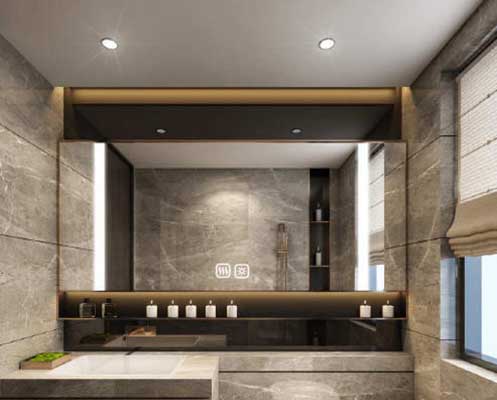
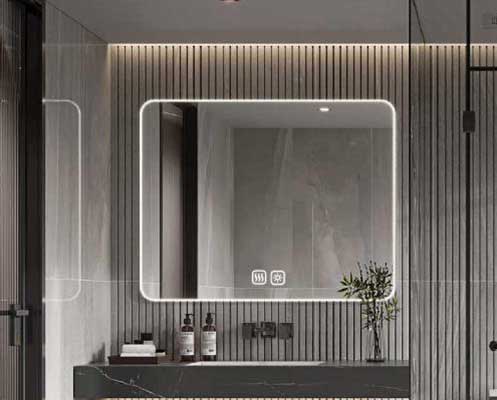
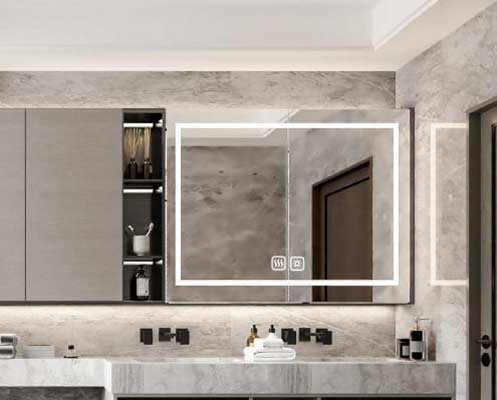
- Front-lit: LEDs face the user. Best for grooming. Eliminates shadows .
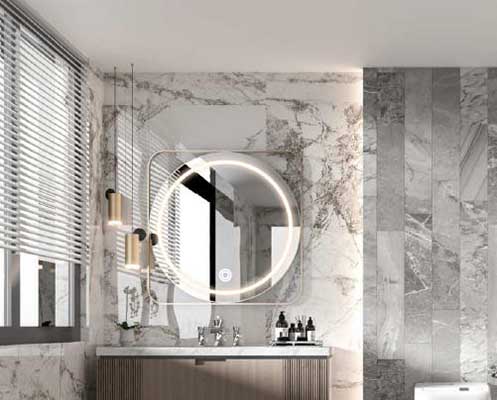
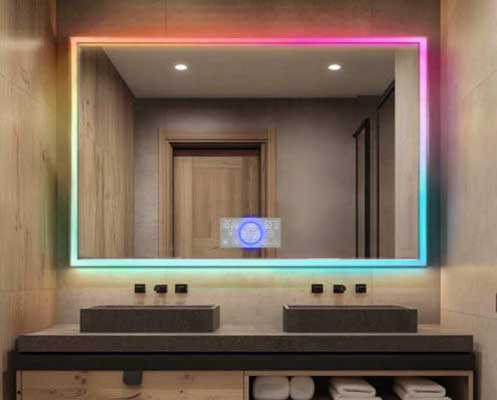
- Backlit (edge-lit): LEDs sit behind the mirror and glow onto the wall. Creates a floating halo effect. Atmospheric, less functional for close work .
LED mirrors are especially effective in dark bathrooms. The light source attaches directly to the reflective surface, so the bounce effect is built in .
5.2 Demister Mirrors: Clear Glass, Better Mood
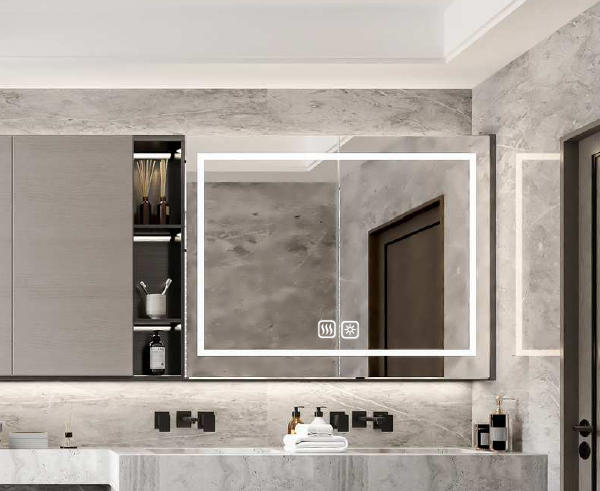
A fogged mirror after a shower is a small frustration that compounds daily. Demister mirrors have a heated pad behind the glass. The pad activates with the mirror and prevents condensation .
In poorly ventilated bathrooms, a demister is not a luxury. It is a functional upgrade that keeps the mirror usable when you need it.
5.3 Smart Mirrors: Control and Customization
Smart mirrors add color temperature adjustment, touch controls, memory functions, and sometimes Bluetooth speakers. The most useful feature is tunable white. You can set 3000K for evening relaxation and 4500K for makeup application in the morning .
The novelty features—speakers, clocks—get mixed reviews. The adjustable color temperature earns its keep.
5.4 Decorative Mirrors: Shape and Frame as Atmosphere
A framed mirror with fluted metal or an arched silhouette adds visual texture without adding light. These mirrors shape ambiance through form, not illumination. They work best when paired with side lighting, since the mirror itself does no light work .
6. Size, Shape, and Placement Rules
6.1 Sizing to the Vanity
The mirror width should be 70% to 90% of the vanity width below it . A mirror narrower than this looks undersized. A mirror much wider can overwhelm the basin area.
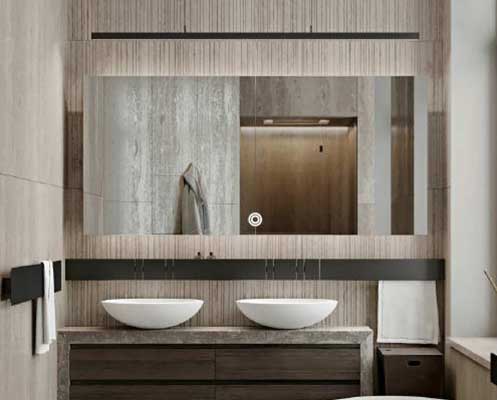
For double vanities, a single wide mirror spanning both basins reflects more continuous light than two separate mirrors . The space-doubling effect is stronger.
6.2 Height and Eye Level
Mount the mirror so its center sits at the average eye height of regular users. For most adults, that is 1550mm to 1650mm from the floor .
Leave 100mm to 200mm between the bottom edge of the mirror and the basin rim. Closer looks crowded. Higher creates a gap .
6.3 Shape and Function
Round and oval mirrors soften tight spaces. Rectangular mirrors suit wide vanities and modern bathrooms. Arched mirrors add vertical emphasis without hard corners .
The shape does not change the optics. It changes how the mirror feels. Both matter.
7. Common Mistakes and Fixes
Mistake 1: Single Overhead Light
Problem: Top shadows on the face.
Fix: Add side sconces at eye level, or switch to a front-lit LED mirror .
Mistake 2: Cool White Bulbs
Problem: 4000K+ light turns skin tones blue and clinical.
Fix: Stay at 2700K to 3000K for residential bathrooms .
Mistake 3: Mirror Facing a Blank Wall
Problem: Reflects nothing interesting. Doubles the blankness.
Fix: Move the mirror opposite a window, a texture, or a feature tile .
Mistake 4: Low CRI Bulbs
Problem: Makeup looks wrong in daylight.
Fix: Use CRI 90+ bulbs at the vanity .
Mistake 5: No Dimming
Problem: One brightness level for all tasks.
Fix: Put vanity lights on a dimmer. Full brightness for grooming, low for evening .
8. Case Studies: Three Bathroom Scenarios
8.1 Small Internal Bathroom (No Window)
Challenge: No natural light. Feels cramped.
Solution: A large backlit LED mirror on the longest wall, opposite the door. The backlight provides atmospheric glow. A front-lit zone in the center handles grooming. Side sconces at eye level eliminate shadows .
Result: The room reads as twice its size. The mirror’s halo creates depth without bulk.
8.2 Dark North-Facing Bathroom
Challenge: Soft, directional light only. The room feels dim even during the day.
Solution: Mirror placed directly opposite the window. The mirror catches the light cone and throws it back across the room. A demister pad keeps the mirror clear after showers .
Result: Perceived brightness increases by roughly 30% to 40% without adding fixtures.
8.3 Luxury Master Bath
Challenge: Large space needs layered lighting and atmosphere.
Solution: A full-width mirror above a double vanity. Side sconces at 60 to 65 inches. A backlit LED strip behind the mirror for evening ambiance. Dimmable controls. Color temperature set to 3000K for warmth, 4000K for grooming tasks .
Result: The mirror acts as both task surface and ambient light source. The bathroom transitions from spa to functional with one dimmer adjustment.
9. Practical Advice: Choosing a Light-Boosting Mirror
Match the Mirror to the Light Problem
If the bathroom is dark, prioritize placement opposite a window or a backlit LED mirror. If the problem is bad task light, prioritize front-lit LEDs or side sconces. If the problem is fog, add a demister.
Check the Specs That Matter
- CRI: 90+ for grooming zones.
- Kelvin: 3000K as the versatile default.
- IP Rating: IP44 minimum for bathroom zones 2 and outside .
- LED Lifespan: 30,000 to 50,000 hours for quality units .
Mock It Up Before You Buy
Cut paper to the mirror dimensions and tape it to the wall. See how it sits relative to the window, the vanity, and the light fixtures. This five-minute step prevents expensive mistakes .
10. Conclusion: The Balance Rule
A bathroom mirror is not just a reflective surface. It is a light management tool. Place it well, and it doubles windows, softens shadows, and makes small rooms feel open. Place it poorly, and it reflects blank walls and amplifies bad lighting.
The balance rule is simple: point the mirror at something bright, light the face from the sides, and choose specs that match the task. Everything else—shape, frame, smart features—is refinement.
FAQ
What color temperature is best for a bathroom mirror light?
3000K to 3500K works best for most bathrooms. This range is warm enough to be comfortable and neutral enough for accurate color rendering. Avoid 4000K and above for residential grooming areas .
Should I put my bathroom mirror opposite a window?
Yes, if possible. A mirror opposite a window reflects natural light back into the room and doubles the perceived brightness. This is one of the most effective no-cost lighting upgrades .
Do I need side lights with an LED mirror?
Not always, but often yes. Front-lit LED mirrors provide good task light on their own. Backlit mirrors provide atmosphere but need side sconces or overhead light for grooming. Most bathrooms benefit from layered lighting .
What CRI do I need for a bathroom mirror light?
CRI 90 or above for grooming tasks. This ensures makeup and skin tones look accurate. CRI 80 is acceptable for general ambient light but can shift colors slightly .
How high should bathroom mirror lights be mounted?
Side sconces should sit at eye level, typically 60 to 65 inches from the floor to the fixture center. Overhead bars should be as close to the mirror top as possible, no more than 5cm above the frame .
Get Intelligent Control Systems with Zoruiyi
Zoruiyi builds smart mirror technology for bathrooms that demand both function and atmosphere. Our intelligent control systems integrate tunable color temperature, memory presets, and dimming into a single touch interface. The mirror becomes the light source—and the control center.